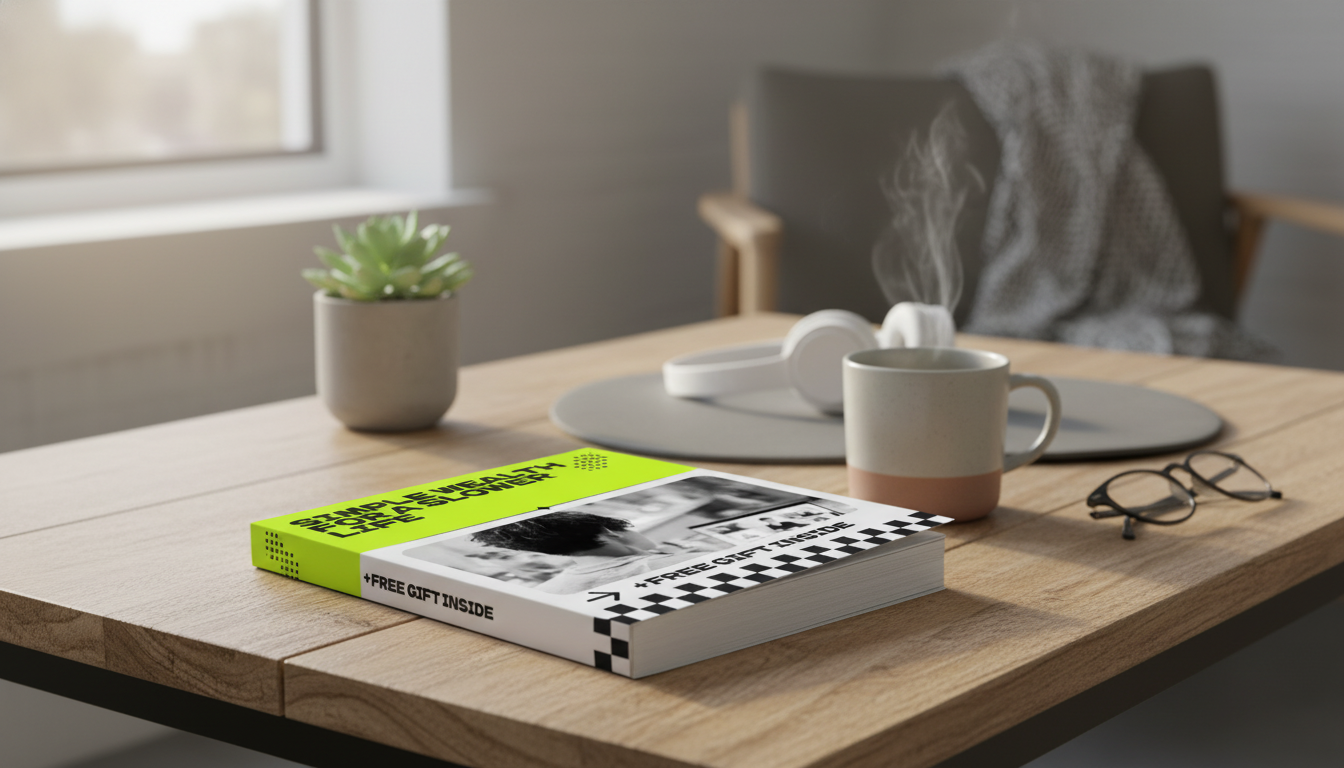
A slower life becomes easier to protect when money is simpler: fewer obligations, steadier cash flow, and clearer choices. Minimalist-friendly passive income focuses on low-maintenance systems—automated saving, broadly diversified investing, and small “set-and-forget” income streams—so time and attention stay available for health, relationships, and meaningful work.
If you want a practical, calm approach you can return to whenever life gets noisy, start with Simple Wealth for a Slower Life – A Practical Guide to Passive Income for Minimalists and Slow-Living Advocates Seeking Financial Freedom & Intentional Living. It’s built around steady systems rather than constant optimization.
Simple wealth isn’t about chasing every possible return. It’s about creating breathing room—financially and mentally—so your days can move at a human pace.
When money is organized around “enough,” the goal shifts: not how fast you can grow, but how calmly you can live.
The simplest passive income strategy is the one that doesn’t have to cover unnecessary overhead. Minimalism shines here: lowering your baseline makes every dollar of passive income more powerful.
| Area | Simple action | Why it supports a slower life |
|---|---|---|
| Subscriptions | Cancel or pause anything unused in 30 days | Cuts recurring mental and financial clutter |
| Bills | Negotiate internet/insurance annually | Lowers fixed costs without lifestyle sacrifice |
| Spending rules | Adopt a 48-hour pause for non-essentials | Reduces impulse buys and regret |
| Debt | Pay off highest-rate debt first (or smallest balances for momentum) | Frees cash flow and reduces stress |
Once your baseline is lighter, automated investing and low-maintenance income streams feel less like “work” and more like quiet support.
Slow-living passive income is less about novelty and more about reliability. Think: fewer moving parts, fewer logins, and fewer emergencies.
| Option | Time to set up | Ongoing effort | Risk level | Best fit for slow living |
|---|---|---|---|---|
| Index fund investing | Low | Very low (automate contributions) | Medium (market risk) | Long-term wealth building with minimal upkeep |
| Treasury bills / savings | Low | Very low | Low | Short-term stability and peace of mind |
| REITs | Low | Low | Medium | Real-estate exposure without tenant management |
| Rental property | High | Medium to high | Medium to high | Only if systems and outsourcing keep life calm |
| Evergreen digital product | Medium | Low to medium | Medium | Good for creators who want bounded, intentional output |
For retirement accounts and tax-advantaged options, keep the rules simple and confirm details through the IRS retirement plans guidance.
Many “passive” ideas fail the slow-living test because they demand constant attention. Guardrails keep you from accidentally building a complicated second job.
If you want a tidy reference you can revisit each month, Simple Wealth for a Slower Life is an easy companion to keep your system simple and repeatable.
For a slower home environment while you focus on long-term systems, small quality-of-life upgrades can help you stay consistent—like a Mini USB Aroma Humidifier & Essential Oil Diffuser with Soft LED Light for a calmer workspace, or a reliable 100W USB-C to USB-C Fast Charging Cable with PD 3.0 & QC 4.0 – 5A Power to reduce everyday friction.
It’s a straightforward approach centered on spending less than you earn, avoiding high-interest debt, building an emergency fund, and investing consistently in low-cost, broadly diversified index funds for long-term growth.
A practical set is: (1) clear goals and values-based spending, (2) strong cash-flow management, (3) emergency fund and insurance, (4) a workable debt strategy, and (5) long-term investing plus diversified income streams. Frameworks vary, but these cover the essentials.
The core themes include keeping finances simple, avoiding lifestyle inflation, using low-cost index funds, staying the course through market cycles, and focusing on financial independence rather than complex tactics.







Leave a comment