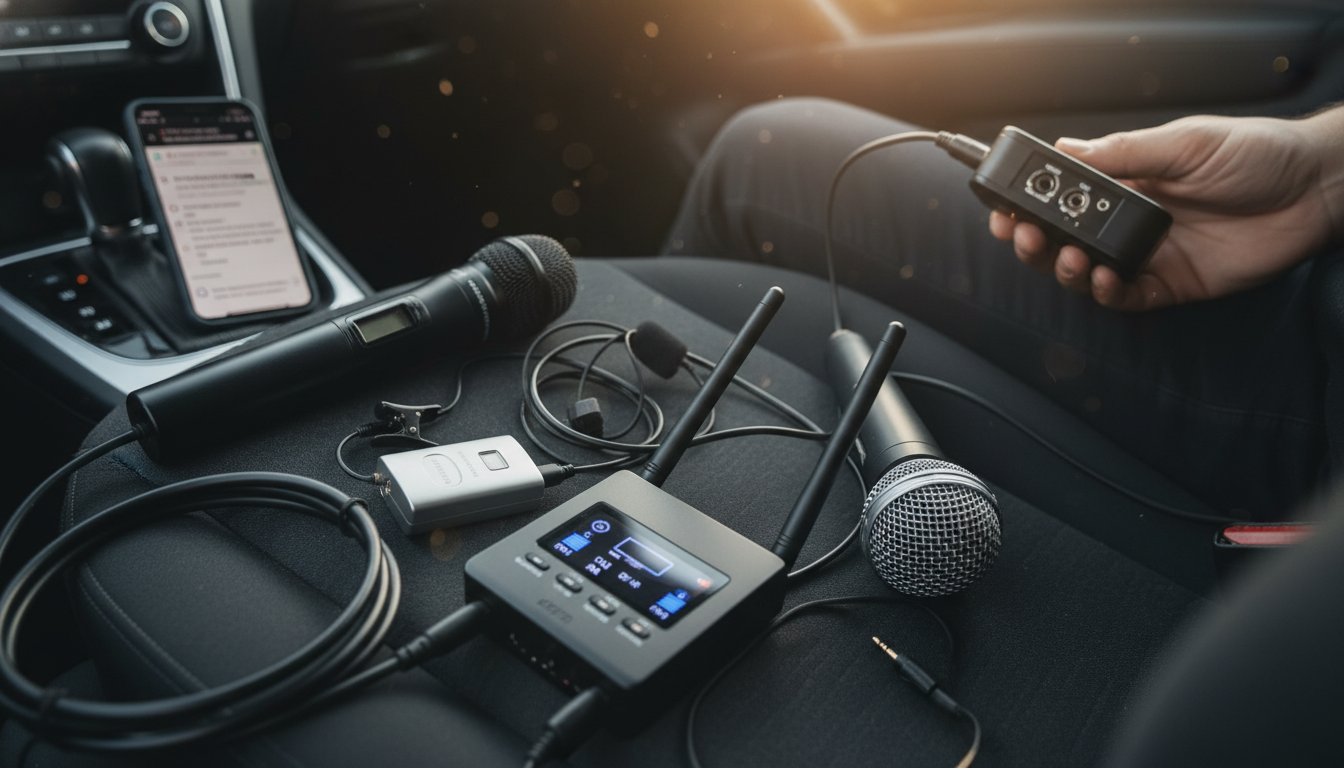
No. A wireless microphone and its receiver must match on both technology and tuning to communicate reliably. “Wireless” covers several different systems, and compatibility depends on frequency band, modulation type, and sometimes brand-specific pairing.
The mic and receiver have to operate in the same band. A UHF handheld won’t talk to a 2.4 GHz receiver, and a Bluetooth microphone won’t connect to a UHF rack receiver. Even within UHF, the mic must fall within the receiver’s tuning range (for example, 470–512 MHz).
Some systems send analog RF, others send digital RF. An analog UHF mic typically won’t work with a digital UHF receiver, even if the frequency range overlaps, because the encoding/decoding methods don’t match.
Many entry-level UHF karaoke sets use fixed channels: the receiver is built to listen on specific frequencies, and the mic is locked to those same frequencies. More advanced systems allow scanning and syncing, but the mic still must be designed for that receiver family.
Even when two products list similar bands, manufacturers may use proprietary companding, digital codecs, or encryption. That’s why a “UHF wireless mic” from one brand usually won’t register with another brand’s receiver unless the manufacturer explicitly states cross-compatibility.
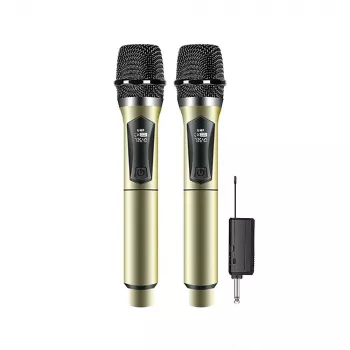
Match the exact model series when possible, then verify: (1) band/range printed on the receiver and mic, (2) analog vs. digital system type, and (3) whether the receiver supports the mic’s channel group. If you’re shopping for a simple setup for karaoke or meetings, a bundled mic-and-receiver kit avoids guesswork. For a practical walkthrough of a rechargeable UHF wireless microphone with receiver, see this guide.
Only if the receiver is a dual-channel (or multi-channel) unit designed for multiple mics. A single-channel receiver can typically handle just one microphone at a time on its assigned frequency.
No. A wireless microphone and its receiver must match on both technology and tuning to communicate reliably. “Wireless” covers several different systems, and compatibility depends on frequency band, modulation type, and sometimes brand-specific pairing.
The mic and receiver have to operate in the same band. A UHF handheld won’t talk to a 2.4 GHz receiver, and a Bluetooth microphone won’t connect to a UHF rack receiver. Even within UHF, the mic must fall within the receiver’s tuning range (for example, 470–512 MHz).
Some systems send analog RF, others send digital RF. An analog UHF mic typically won’t work with a digital UHF receiver, even if the frequency range overlaps, because the encoding/decoding methods don’t match.
Many entry-level UHF karaoke sets use fixed channels: the receiver is built to listen on specific frequencies, and the mic is locked to those same frequencies. More advanced systems allow scanning and syncing, but the mic still must be designed for that receiver family.
Even when two products list similar bands, manufacturers may use proprietary companding, digital codecs, or encryption. That’s why a “UHF wireless mic” from one brand usually won’t register with another brand’s receiver unless the manufacturer explicitly states cross-compatibility.
Match the exact model series when possible, then verify: (1) band/range printed on the receiver and mic, (2) analog vs. digital system type, and (3) whether the receiver supports the mic’s channel group. If you’re shopping for a simple setup for karaoke or meetings, a bundled mic-and-receiver kit avoids guesswork. For a practical walkthrough of a rechargeable UHF wireless microphone with receiver, see this guide.
Only if the receiver is a dual-channel (or multi-channel) unit designed for multiple mics. A single-channel receiver can typically handle just one microphone at a time on its assigned frequency.



Leave a comment